The NEWP Lab is excited to welcome Kilian Kozerke to the group!
Kilian comes to Cambridge from Rhenish-Westphalian Technical University (RWTH) in Aachen, Germany, where he is pursuing a postgraduate course in the Department of Mechanical Engineering. Many students in RWTH’s (M.Sc) in Mechanical Engineering and Business Administration programme undertake an externally-supervised independent thesis project to expand their analytical breadth and apply their interests and training to real-world engineering challenges. Kilian’s thesis will be supervised by Dr. Nathanial Cooper at NEWP in the IfM.
Kilian’s research builds on his interest in recent work published by Jain et al. in Water Research in which the authors analyze gallium recovery from low-concentration semiconductor wastewater streams using highly selective complexation methods [1]. Kilian plans to extend this work by focusing on the simultaneous recovery of gallium from semiconductor wastewater streams and hydrogen production from the treated effluent for reuse in fabrication processes. With his six-months at the NEWP lab, Kilian will develop a process model grounded in first-principles mass and energy balances to evaluate and optimize system design. This approach will be coupled with both a techno-economic analysis, using scaling relationships and cost estimation methods to assess feasibility, and a life cycle assessment implemented in OpenLCA with the ecoinvent database to quantify environmental impacts across the system. Taken together, this approach will provide a holistic evaluation of how wastewater streams traditionally considered a liability can instead serve as sources of both critical materials and clean energy carriers.
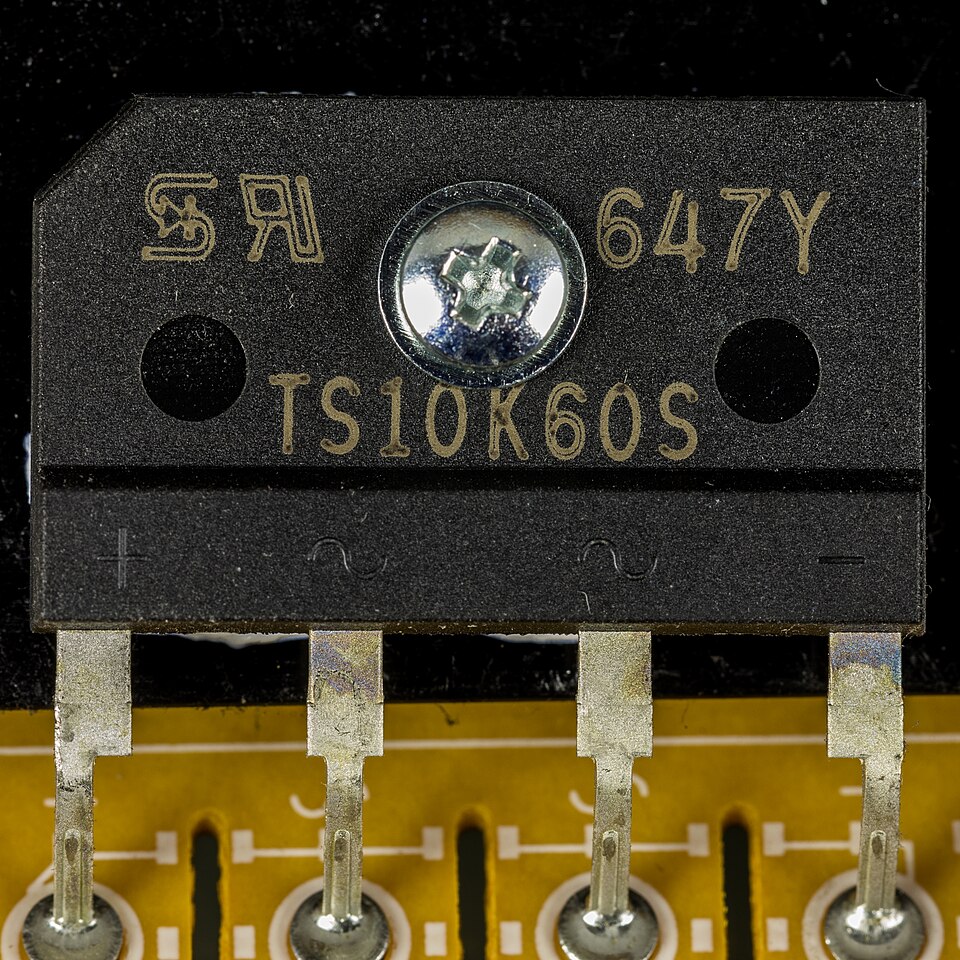
Fig. 1: Samsung UE40MU6409U – power supply board – Taiwan Semiconductor TS10K60S – Glass Passivated Bridge Rectifier, 4 December 2022, uploaded by Raimond Spekking and accessed via Wikimedia Commons. © Raimond Spekking / CC BY-SA 4.0 (via Wikimedia Commons). Public Domain.
Kilian’s project reflects a growing need to move beyond single-process innovations and forward, toward connected, scalable solutions which operate across the water–energy nexus. Gallium is a critical material in modern technologies, particularly in semiconductors and high-efficiency photovoltaics, yet its supply is increasingly constrained. At the same time, large volumes of gallium are lost in low-concentration industrial wastewater streams, where conventional recovery methods are often economically unfeasible. Building on recent advances in selective gallium complexation from real semiconductor wastewater streams, Kilian’s work explores how these emerging recovery pathways can be translated into integrated, system-level solutions.
This work extends NEWP’s research in wastewater valorization by advancing integrated recovery pathways which link material circularity with energy production, a key priority in the transition to low-carbon, resource-efficient industrial systems. By recovering gallium, the process has the potential to reduce reliance on primary extraction, stabilize supply chains for clean energy technologies, and lower the material costs associated with photovoltaic and semiconductor manufacturing. Simultaneously, hydrogen generation from treated water streams offers a pathway to on-site energy reuse within industrial operations, improving overall system efficiency.
Recognizing the opportunity to move beyond recovery alone, Kilian has framed this work around a more integrated system design which connects resource recovery with energy generation and industrial reuse, addressing both a technical challenge and its broader implications for critical material supply chains. For industry, the value of this approach is clear: they offer pathways to reduce waste, recover high-value materials, integrate energy systems directly into existing infrastructure, and supporting economic resilience as well as environmental health. For the research community, his contribution speaks to the importance of combining methodologies (from process design, data-driven modeling, and systems analysis) to translate promising concepts into deployable technologies. Kilian’s interests represent where the intersection of resource recovery and industrial sustainability can form sustainable pathways to improving clean energy infrastructure through collaborative, systems-focused research. The NEWP Lab is excited to host this collaboration and look forward to seeing how his work develops.
Welcome to Cambridge, Kilian!
The NEWP Lab can accommodate visiting postgraduate students.
The NEWP Lab hosts a limited number of visiting postgraduate researchers who seek to engage in focused, high-impact research within our group over a shorter period of time. Visiting students remain enrolled at their home universities while contributing to carefully defined projects which align with our work in sustainable water and energy systems. Their time in Cambridge is structured by close academic supervision, integration into active research initiatives and social circles, and engagement with our broader academic and industry networks. The NEWP Lab seeks projects motivated by a desire to improve environmental health, social outcomes, and industrial sustainability. Prospective inquiries should communicate real-world relevance and a commitment to academic rigor. Students are encouraged to initiate a conversation about their interests and where they may benefit from supervision within our lab.